
support role guide for moba games is really about one thing: making your team’s fights easier than the enemy team’s fights, even when your scoreboard looks “quiet.” If you’ve ever warded a lot, peeled a lot, and still lost, it usually means your value wasn’t landing at the right time or place.
Support is also the role where small decisions snowball fast. A late rotation, a greedy ward, a mistimed engage, those tiny moments can flip an objective, then flip the whole match. The good news is that support fundamentals transfer across most MOBAs, even when kits and items change.
What this guide does is keep it practical: how to choose a support style that fits your lobby, where your time actually matters, and how to translate “good support play” into towers, dragons, barons, or whatever your game calls the win condition.
What a “Good Support” Really Means in Most MOBAs
Forget the stereotype that support equals “healer” or “ward bot.” In most titles, support is a tempo role: you influence when fights start, when they end, and who gets to play the map safely.
- Enable carries: keep your highest damage or win-condition hero alive long enough to do their job.
- Create information: vision, scouting, tracking cooldowns, and reading rotations.
- Control space: zoning, peeling, disengage, and threat presence so enemies can’t walk where they want.
- Fix the map: roam to stabilize losing lanes, escort waves, and help secure neutral objectives.
In practical terms, supports “win” when their team starts objectives earlier, takes fights on better angles, and wastes less time walking blind into danger.
Why Support Feels Hard: Common Reasons You’re Not Impacting Games
A lot of frustration comes from doing correct things at the wrong moment. Here are issues that show up across games and ranks.
- Over-focusing on lane: staying glued to your carry while the rest of the map collapses. Lane safety matters, but the map often matters more after the first few minutes.
- Vision without purpose: placing wards where you “usually” ward, not where the next fight will happen.
- Roaming at the wrong time: leaving when your wave state is bad, or roaming without a clear target (mid gank, invade, objective setup).
- Forcing engages: starting fights because your kit can, not because your team can follow.
- Item choices that don’t match the lobby: building “standard” when you actually need cleanse, anti-heal, armor, or utility.
According to Riot Games, vision control and objective setup are core skills tied to winning games in League of Legends, and that logic generalizes: information and timing create cleaner fights than raw mechanics.
Quick Self-Check: Which Support Situation Are You In?
If you want this support role guide for moba games to help fast, categorize your problem first. Different problems need different fixes.
- You win lane but lose mid game: your rotations and objective setups likely lag behind the game pace.
- You lose lane often: trading fundamentals, matchup understanding, and wave timing need work.
- Your ADC/carry dies “randomly”: you may be warding too shallow, hovering wrong angles, or saving peel tools for too late.
- You feel useless when behind: you might be playing engage-only champs without reliable disengage or safe vision patterns.
- You die a lot while warding: your vision routes and timing are predictable, or you’re warding without lane priority.
Key takeaway: stop trying to “do more,” start doing fewer actions that directly connect to the next objective or fight.
Core Fundamentals: Positioning, Vision, and Tempo
Positioning: be close enough to act, far enough to live
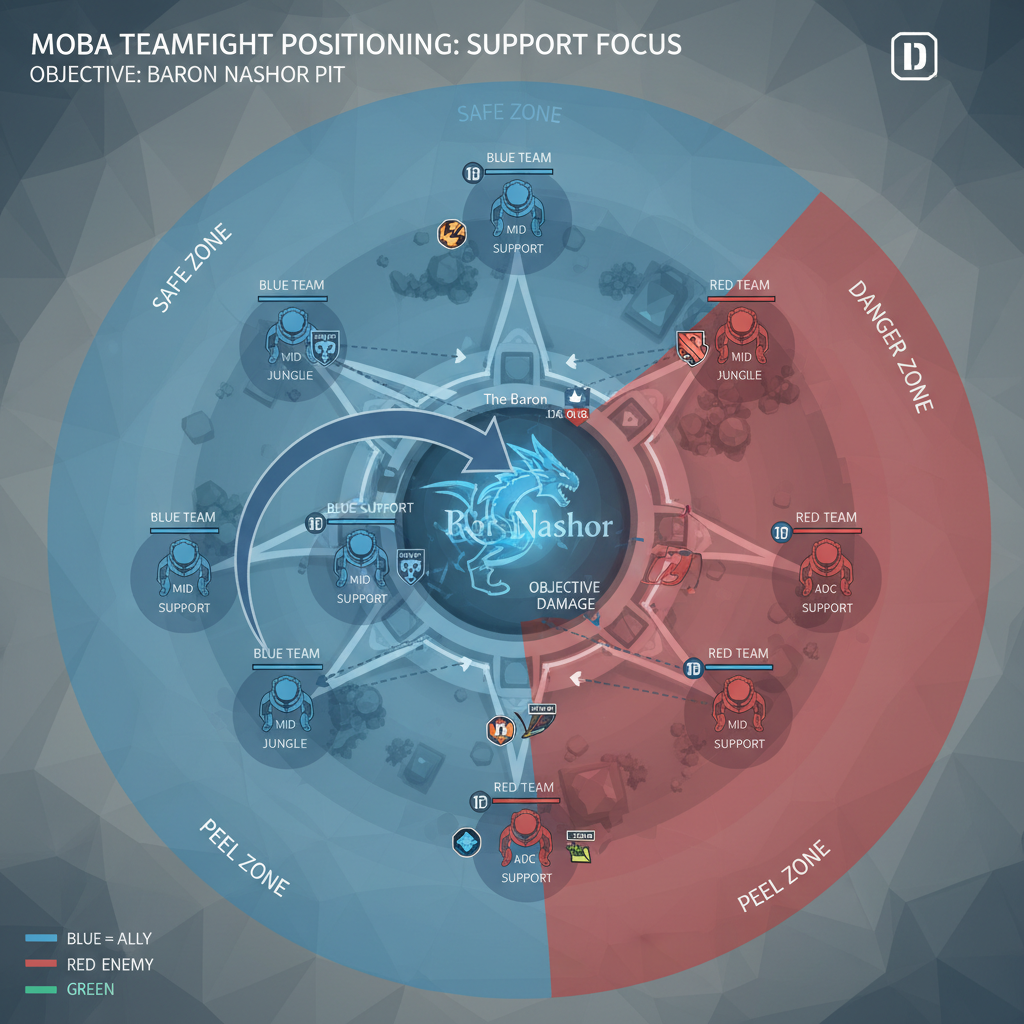
Support positioning is mostly about angles. You want to stand where you can threaten a skill, block a path, or peel, without being the first target.
- Versus dive/assassins: hover near your carry’s escape route, keep crowd control ready, don’t step past the frontline.
- Versus poke: stand slightly off to the side, so one skillshot can’t hit you and your carry together.
- When you’re the engager: show pressure from fog-of-war, not from the middle of the lane.
Vision: place information where decisions happen
Good vision is less about quantity, more about timing and location. A ward that spots a rotation to the next objective can be worth ten “comfort wards” that see nothing.
- Before objectives: ward entrances and flanks, then back off so you’re alive when the fight starts.
- After winning a fight: push vision deeper, because enemies are off the map and can’t punish you as easily.
- When behind: ward closer to your safe paths and key jungle entrances, avoid face-checking alone.
Tempo: your time is a resource
If you walk to a side lane and nothing happens, you didn’t just “waste 20 seconds,” you probably missed your window to secure vision, reset, or group. Supports should think in short cycles: crash wave, ward, reset, group.
Practical Playbook by Game Phase (Early, Mid, Late)
Early game: lane control without overcommitting
- Trade with a reason: poke to create space for your carry to farm or push, not just to pad damage.
- Track the enemy jungler: if you saw them top 20 seconds ago, you can often play up; if you haven’t seen them, assume they’re near you.
- First roam rule: roam after you help set a good wave state, so your carry isn’t forced into a 1v2 under pressure.
Mid game: objectives decide your value
Mid game is where support players either take over or disappear. Your priority becomes: setup, escort, and deny flanks.
- Move with whoever can safely face-check (often jungle or tank), not alone.
- Start vision 45–90 seconds before an objective, depending on map size and death timers.
- If your team wants to fight, position for engage; if your team wants to scale, save cooldowns to disengage.
Late game: one death can end it
Late game support is often boring on purpose. You trade “cool plays” for consistency.
- Don’t show alone: revealing yourself on a side lane can give enemies a free start on the big objective.
- Peel beats chase: protecting your damage dealer usually outvalues trying to finish a low HP target.
- Control the first 3 seconds: late fights often hinge on the first pick or the first saved carry.
Build and Champion/Character Choices: Match the Lobby, Not the Meta
This is where many supports quietly throw games: they copy a build without asking what problem they must solve. Use this table as a quick “what should I optimize for?” check.
| Enemy Threat | What You Usually Need | Support Mindset |
|---|---|---|
| Dive + assassins | Peel tools, defensive actives, vision near flanks | Stand between danger and carry |
| Heavy poke | Sustain/shields, engage windows, anti-poke positioning | Survive, then force clean fights |
| Tanky frontline | Disengage, anti-heal (if game has it), % damage enable | Stretch the fight, don’t panic |
| Pick/CC comps | Cleanse tools, spacing, warding defensively | Respect fog-of-war, deny picks |
When choosing a support style, a simple rule holds across most MOBAs: if your team lacks initiation, pick an engager; if your team has plenty of engage but no protection, pick peel or disengage. This support role guide for moba games is less about “best champs” and more about covering the missing function.
Step-by-Step: A Repeatable Support Routine You Can Run Every Game
If you only take one actionable system, make it this. It reduces decision fatigue and keeps you on the right side of the map more often.
- Reset timing: recall when your team can safely reset too, so you don’t return alone with no map control.
- Objective timer check: identify the next neutral objective and start moving your vision and body toward it early.
- Two-ward rule: place one “information” ward (sees rotations) and one “fight” ward (sees the flank) before you commit.
- Hover the win condition: if one teammate is ahead, play around them even if it annoys the lane partner.
- Fight plan: decide before contact if you’re engaging, counter-engaging, or peeling, then save the right cooldown.
One more thing that’s easy to ignore: if you’re behind, your “routine” becomes safer and smaller. Ward closer, group earlier, and trade objectives instead of forcing 50/50 fights.
Common Mistakes That Look Like “Good Support” (But Aren’t)
- Dying for vision: a ward is rarely worth your life when an objective is spawning soon. In many cases, being alive with zero wards is more useful than being dead with great wards.
- Perma-roaming: roaming can win games, but abandoning your carry into repeated dives can also lose games fast.
- Engaging without numbers: if your mid is catching a wave and your jungler is resetting, your engage is basically a solo queue highlight attempt.
- Using peel too early: blowing your stun or knockback on the first target you see, then watching the assassin clean up your backline.
- Ignoring wave states: supports don’t need perfect wave management, but you do need to notice when your team can’t move first.
According to Valve, Dota 2 is built around team coordination and information control, and support play often decides which team gets to take favorable fights. The same principle applies even in faster, more brawl-heavy MOBAs.
When to Seek More Help (Coaching, VOD Review, or Team Practice)
If you’ve tried a consistent plan for a couple weeks and results stay flat, outside feedback can help, especially for supports where mistakes are subtle. Consider getting help when:
- You regularly die first and can’t explain why beyond “I got caught.”
- Your vision “feels fine,” but your team still loses every objective setup.
- You don’t know what you should be doing after lane ends, so you follow teammates randomly.
VOD review tends to work best when you pick one theme, like roam timing or ward routes, and look for repeated patterns. If you use paid coaching, it’s usually smart to choose reputable services and avoid anyone promising guaranteed rank results.
Conclusion: Play Support Like a Map Player, Not a Sidekick
The support role is not about chasing kills or stacking stats, it’s about stacking advantages your team can actually convert. If you want faster improvement, run one repeatable routine: prep the next objective early, ward for the next fight, and hover the teammate who can carry the game state.
If you only do two things after reading this support role guide for moba games, make them these: stop warding alone when objectives are close, and decide your fight job before the fight starts. That alone changes a lot of games.
FAQ
What is the most important skill in a support role guide for moba games?
Timing, especially around objectives. Mechanics help, but being early to vision and positioning often creates easier fights than landing one flashy combo.
Should supports roam a lot in MOBAs?
Roaming is strong when your lane state allows it and you have a clear goal. If roaming leaves your carry repeatedly dove, it usually becomes negative value even if you “helped mid once.”
How do I ward safely when I’m behind?
Ward closer to your team’s safe routes and move with at least one teammate who can survive a check. Many players try to “fix” vision alone while behind, and that’s where chain deaths begin.
Is it better to play engage supports or enchanters?
It depends on what your team lacks and what the enemy comp threatens. Engage supports can win tempo, enchanters can stabilize and scale, and both can carry if they match the lobby’s needs.
How do I know if I should peel or engage in a fight?
Look at who actually wins your team the fight. If your carry is fed or essential to your comp, peel more. If your team wins by starting first and bursting a target, engage becomes higher priority.
Why do I feel underleveled or underfarmed as support?
That’s normal in many MOBAs, but you can reduce it by timing resets well and avoiding dead-time wandering. Also be careful not to over-share lane XP when you don’t need to.
What’s a simple way to improve my support gameplay quickly?
Pick one focus for a week, like “objective setup 60 seconds early,” and track whether you arrive first and survive. Improvement shows up faster when you narrow the goal instead of changing everything at once.
If you’re trying to climb but your games feel chaotic, it can help to treat support like a checklist role: show up early for the next objective, place vision that answers a question, and stick to a clear fight job. If you want, share your game, rank, and the support style you play, and I can help you tailor the routine to your meta and champion pool.